Table of Contents
In the early stages of the Australian startup ecosystem, capital is the most volatile resource an inventor possesses. The natural impulse for any creator is to present their vision in its most polished, feature-complete form. However, this "perfectionist's bias" often leads to the premature exhaustion of funds on secondary features that have not yet been validated by the market. To navigate the financial constraints of modern manufacturing, one must master the art of the Minimum Viable Prototype (MVP) - a process that requires stripping an invention down to its absolute mechanical or digital core.
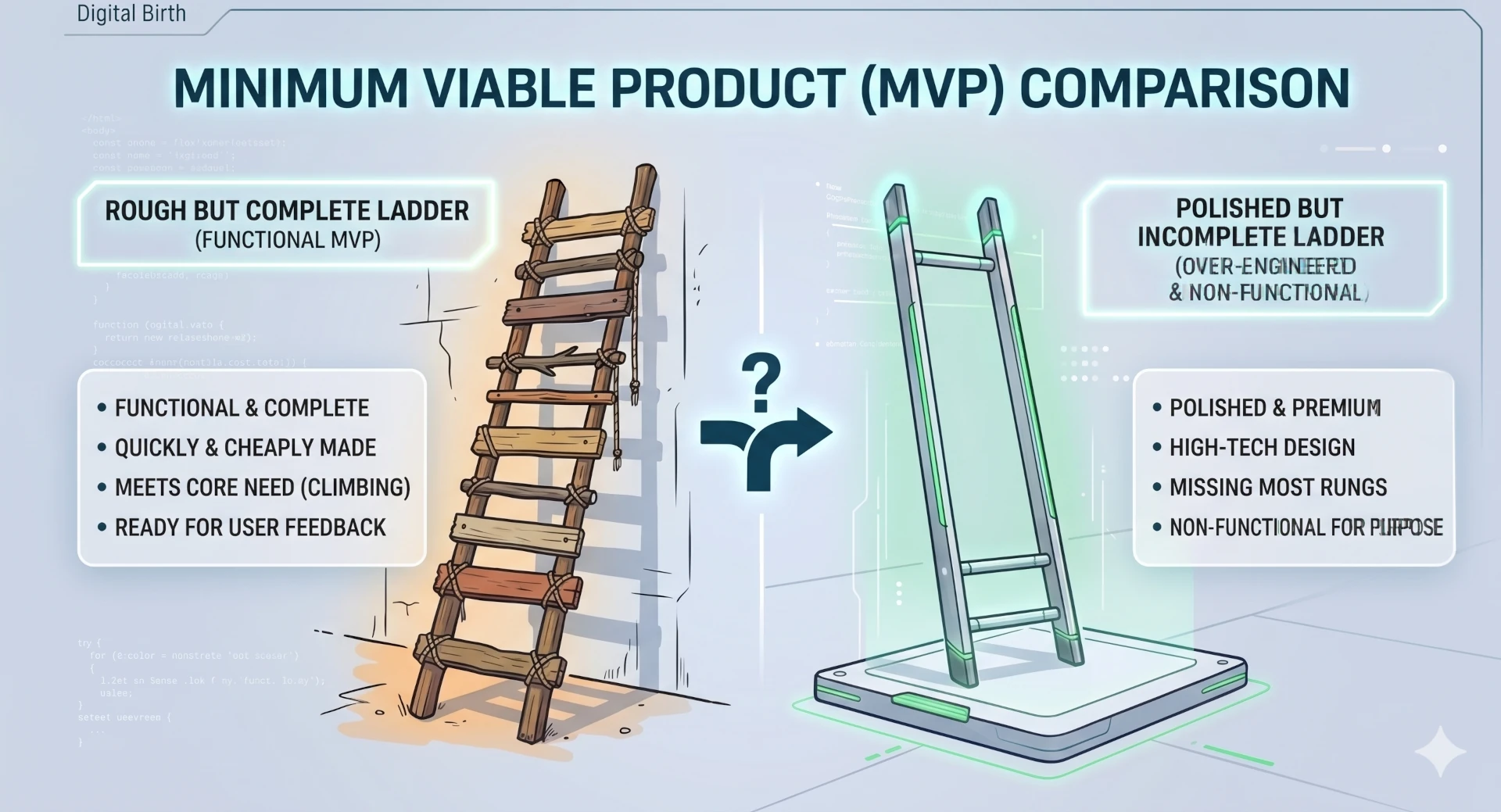
The foundational logic of the MVP is built upon the distinction between a "Works-Like" prototype and a "Looks-Like" prototype. Many inventors waste thousands of dollars in early iterations trying to achieve both simultaneously. A "Works-Like" prototype ignores aesthetics entirely, utilizing off-the-shelf components, exposed wiring, or unfinished 3D prints to prove that the core mechanism functions as intended. By isolating the technical challenge from the industrial design, an inventor can solve the most difficult engineering hurdles for a fraction of the cost of a fully housed unit.
Determining the "core function" of an invention requires a ruthless level of clinical detachment. If you are developing a revolutionary new kitchen appliance, the core function is the heating or mixing mechanism, not the digital display or the Bluetooth connectivity. In the Australian context, where specialized labor and precision machining come at a premium, every additional feature added to a prototype increases the complexity of the "Bill of Materials" and the time required for assembly. Focusing exclusively on the primary value proposition ensures that if the core technology fails, you have discovered this fatal flaw before investing in the peripheral aesthetics.
This lean approach to prototyping also serves as a strategic defense against "Feature Creep." When an inventor attempts to build a high-fidelity prototype too early, they often find themselves tweaking minor details - such as the texture of a plastic casing or the hex code of a status LED - rather than refining the internal logic that provides the actual utility. By maintaining a stripped-down prototype, the inventor remains agile. If initial testing suggests that the user interaction needs to change, the cost of pivoting is negligible because there is no expensive, custom-tooled housing to discard.
Furthermore, the MVP serves as a vital tool for communicating with early-stage investors and manufacturers. A functional, albeit unpolished, prototype demonstrates a level of technical maturity that a simple CAD rendering cannot match. It proves that the "laws of physics" have been satisfied. In the Australian market, where investors are traditionally more risk-averse, showing a prototype that effectively solves the "hard problem" while acknowledging that the "packaging" is yet to come demonstrates a sophisticated understanding of resource management and the commercialization pathway.
Ultimately, stripping an invention down to its core is not about delivering a lesser product; it is about ensuring the product survives long enough to reach maturity. By de-risking the primary functionality of the device through a Minimum Viable Prototype, inventors can preserve their capital for the inevitable expenses of regulatory compliance, mass production, and market entry. In the landscape of innovation, the leanest designs are often the ones that have the most room to grow.
Every added feature at the early stage multiplies your costs and extends your timeline. To survive the initial phase of development, you must embrace the Minimum Viable Prototype (MVP): a version of your invention that does exactly one thing perfectly, and nothing else.
1. The "Main Thing" is the Main Thing
Every successful invention solves a specific pain point. If you are designing a new type of ergonomic chair, the "Main Thing" is the support mechanism, not the fabric color or the swivel tension.
- The Action: Identify the single technical assumption that makes or breaks your product.
- The Logic: If your core mechanism doesn't work, the aesthetic flourishes are irrelevant. By stripping away secondary features, you focus your limited budget on proving the Primary Value Proposition.
2. The "Frankenstein" Method: Using Off-the-Shelf Parts
Custom-engineered parts are expensive. For your first prototype, they are also usually unnecessary.
- The Action: Scavenge. Use existing motors, sensors, or structural components from other products to build your proof-of-concept.
- The Saving: Why pay $2,000 for a custom-machined bracket when a $10 part from a hardware store and some industrial adhesive can prove the same mechanical principle? The goal is to validate the math, not the manufacturing process - at least not yet.
3. Aesthetic Minimalism (Ugly is Okay)
There is a psychological hurdle in showing an "ugly" prototype to potential partners or investors. However, professional investors actually prefer a raw prototype that works over a beautiful one that doesn't.
- The Roadmap: Use "Low-Fidelity" materials. 3D printing, laser-cut acrylic, or even heavy-duty foam board are acceptable for an MVP.
- The Saving: Polishing and painting a prototype can add days of labor and hundreds of dollars to the bill. In the MVP stage, "form follows function" isn't just a design philosophy; it’s a financial necessity.
4. Testing the "Big Risk" First
In engineering, we often talk about the Critical Path. These are the hurdles that, if not cleared, mean the project is dead in the water.
- The Logic: Don't spend money on the easy parts first. If your invention requires a specific battery life to be viable, build a rig that tests only the power consumption.
- The Saving: By tackling the hardest technical challenge with a stripped-down prototype, you avoid spending thousands on the "easy" parts of an invention that might eventually be discarded due to a fundamental flaw in the core tech.
5. Conserving Capital for the Pivot
Almost no invention survives its first contact with users without needing a change. If you spend 90% of your budget building a "perfect" first prototype, you will have 0% left when the test results tell you that the design needs to be inverted.
- The Roadmap: Aim to spend no more than 20% of your initial R&D budget on your first physical MVP.
- The Saving: This "Dry Powder" (liquid cash) allows you to pivot. The MVP is designed to fail - or rather, to tell you how it will fail - so that your second, more expensive version has a much higher chance of success.
The Reality Check
The Minimum Viable Prototype is an exercise in discipline. It requires you to be clinical about your own "baby." By stripping the invention down to its barest bones, you aren't being cheap; you are being strategic. In the Australian startup ecosystem, where capital is tighter than in the US or Europe, the ability to prove a concept for $2,000 instead of $20,000 is the difference between an inventor and a business owner.